Chapter 3: Survival Disguised as Ambition
Before the world became quiet, Vera used to measure her worth by how exhausted she was willing to become.
Long hours meant discipline.
Stress meant ambition.
Burnout meant she was trying hard enough.
At least that was what everyone seemed to believe.
Even now, weeks into lockdown, her body still moved as if rest needed permission she had not earned yet.
She woke every morning already mentally preparing for tasks before her eyes fully opened. Emails. Deadlines. Family obligations. Follow-ups. Groceries. Bills. Messages she needed to answer before people started assuming something was wrong.
Because when dependable people suddenly became unavailable, others noticed immediately.
Vera had built her entire adulthood around never becoming difficult for anyone else.
The apartment was unusually warm that evening.
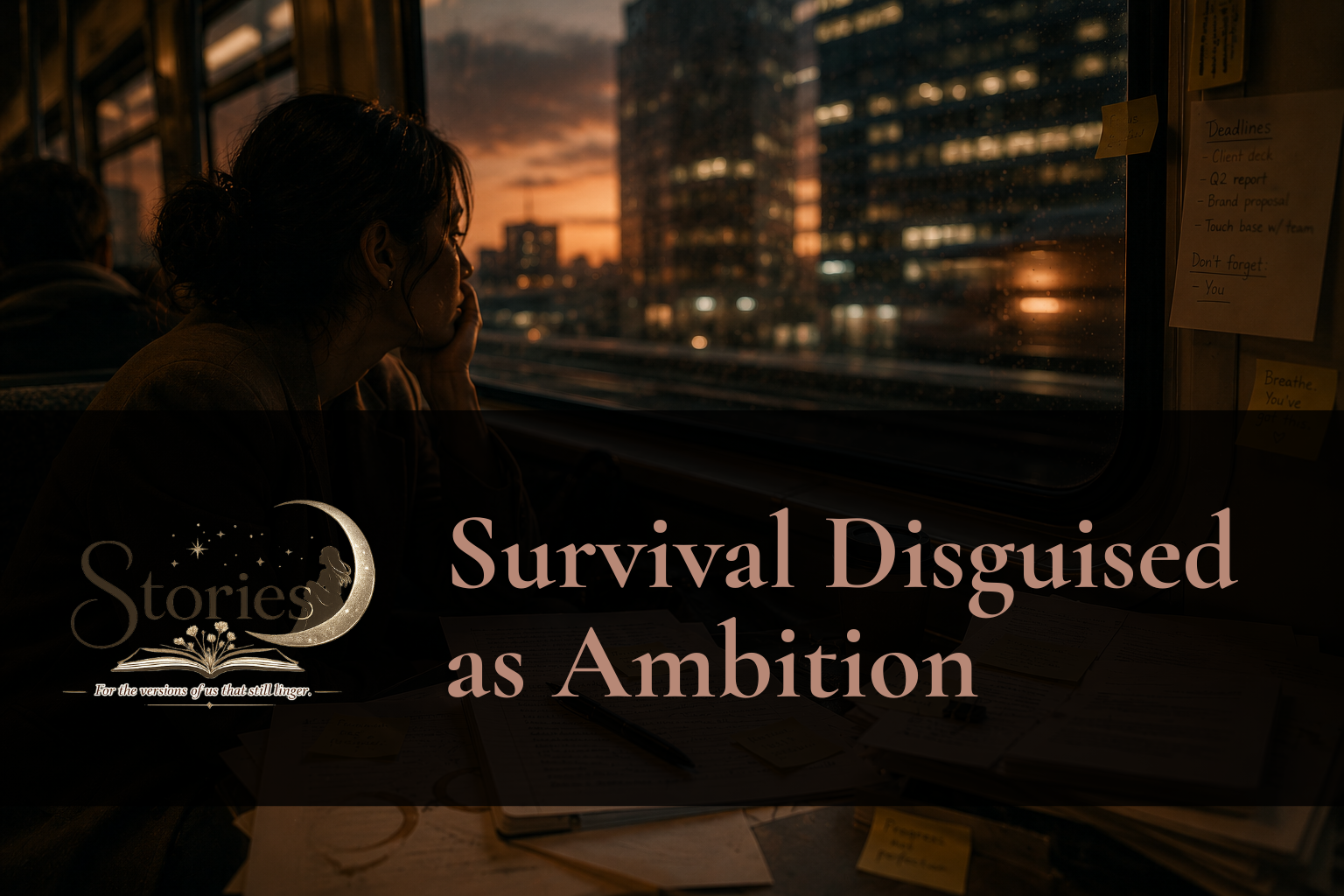
Outside, the sunset dissolved quietly into muted orange and gray, the city skyline softened beneath haze and distant rainclouds. The roads below were emptier than they used to be, though occasionally headlights still drifted past like ghosts of routines nobody fully knew how to let go of.
Her laptop screen glowed against the dining table.
Three unfinished tasks remained open.
Beside them:
- coffee stains
- scattered paperwork
- sticky notes filled with reminders
- a planner still pretending the future could be organized neatly
Vera stared at everything without moving.
She was working less than before technically.
Yet somehow she felt more tired now.
Maybe because distractions had disappeared.
Back then, movement used to protect her from herself.
Commutes.
Meetings.
Deadlines.
Noise.
Schedules packed tightly enough to leave no room for reflection.
Now there was only stillness.
And within that stillness, uncomfortable truths had started surfacing one by one.
The first was this:
Vera did not know who she was outside productivity.
The realization followed her everywhere lately.
She noticed it when she tried resting and immediately felt guilty.
When unfinished tasks made her anxious even after midnight.
When relaxing for an hour somehow felt irresponsible.
As if her value decreased the moment she stopped performing usefulness.
She leaned back in her chair and rubbed both hands across her face slowly.
At some point during her twenties, ambition had stopped feeling inspiring and started feeling necessary.
Not dream-driven necessity.
Survival necessity.
Work harder.
Earn more.
Become indispensable.
Stay useful.
Do not fall behind.
The rules had embedded themselves into her so deeply she no longer questioned them.
Even now, during a global crisis, part of her still felt guilty for slowing down.
Her phone lit up beside the laptop.
A message from an old university friend.
“You’ve always been the hardworking one.”
“Honestly I envy your discipline.”
Vera stared at the words for a long moment.
Discipline.
Funny how people romanticized exhaustion when it looked organized enough.
They did not see:
- the panic underneath overachievement
- the fear of becoming financially unstable
- the loneliness hidden beneath independence
- the emotional suppression required to remain functional all the time
Ambition looked admirable from the outside.
Few people asked what it was protecting.
She set the phone down carefully.
The truth was, Vera had spent years outrunning vulnerability through accomplishment.
Success gave her structure.
Productivity gave her distraction.
Goals gave her identity.
As long as she kept moving, she never had to sit still long enough to examine what was missing.
And there was so much missing.
Rest.
Joy.
Connection.
Softness.
Presence.
Things that could not be measured through performance.
The apartment darkened gradually around her as evening disappeared completely.
She forgot to turn the lights on.
For a while, Vera simply sat in silence watching the city outside transition into night. A train passed somewhere in the distance, its faint metallic sound echoing briefly through the humid air.
Suddenly she remembered something her former manager once told her years ago.
“You’re dependable because you never let emotions interfere with work.”
At the time, she had taken it as praise.
Now the memory unsettled her.
Because maybe emotional suppression was not professionalism.
Maybe it was survival adaptation.
A coping mechanism polished until society rewarded it.
The thought stayed with her heavily.
Vera stood and walked toward the kitchen, stepping carefully around stacks of papers she had promised herself she would organize weeks ago.
She poured another cup of coffee even though her hands already felt slightly shaky from the first two.
Outside, rain finally began falling again.
Soft at first.
Then steady.
She rested against the counter listening to it.
There was a strange grief in realizing how much of her personality had been built around surviving difficult seasons she never fully recovered from.
Even harder was realizing she no longer knew how to exist without preparing for disaster.
Her entire nervous system had become future-oriented.
Hypervigilant.
Productive.
Alert.
Peace felt unfamiliar.
Sometimes even undeserved.
The rain intensified against the windows.
Vera looked down at the coffee warming her hands.
Somewhere over the years, ambition had quietly transformed into self-abandonment wearing expensive language.
Growth.
Discipline.
Hustle.
Independence.
Words people applauded without questioning what they cost.
For the first time in a long while, Vera wondered what her life would have looked like if survival had not always been the main thing shaping it.
The thought felt so unfamiliar she almost pushed it away immediately.
But this time, she let it stay.